At the start of the academic year, some version of “students these days” often arises. This time it is in the form of AI cheating. There have been a few recently published reports on this matter.
In Science, “Generative AI use and misuse call for assessment reform in higher education” (Chirikov, Smirnov, and Kzilcec) looked at 95K students at 20 US public research universities. Here is chart from their article detailing AI use by major.
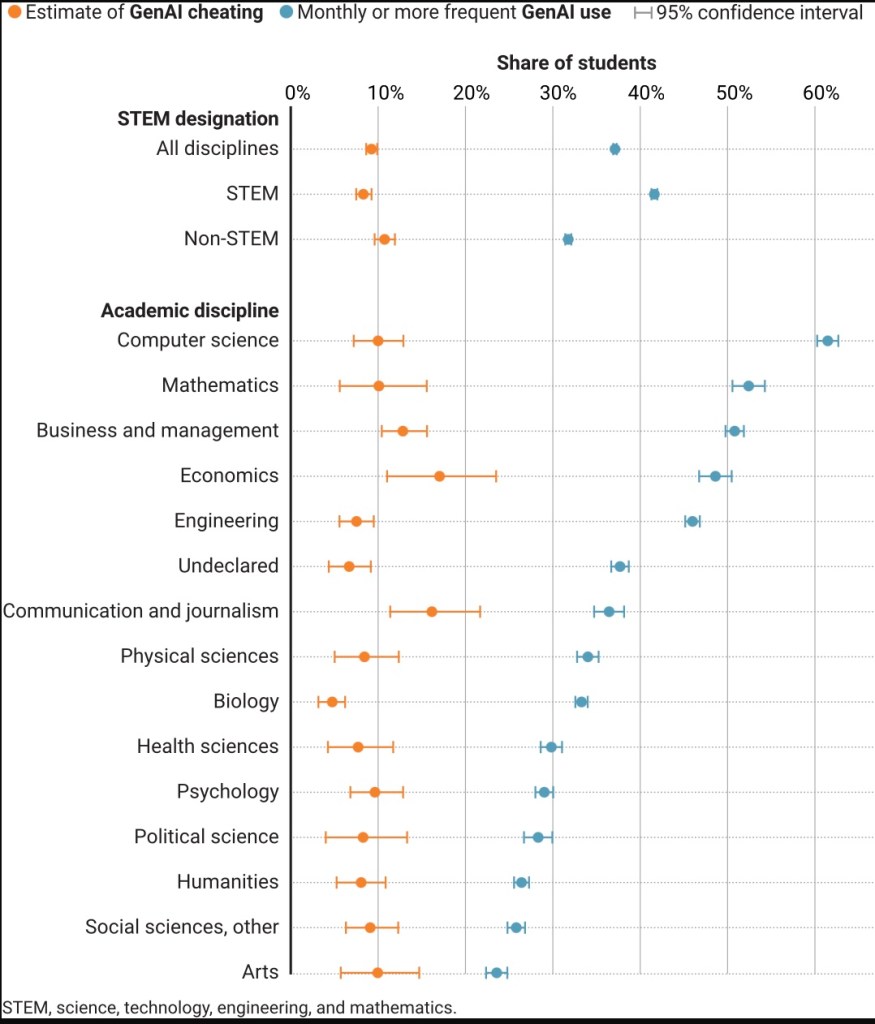
Since Pew reports that about half of all adults and 2/3 of those aged 18-29 say they have used AI, we can put these numbers in that context. In part the chart reflects the adoption of AI within disciplines. So in computer science, where there are many accepted uses for AI, there is significant AI use. It is also possible that in disciplines where there are fewer acceptable uses for AI, a greater share of uses will end up being “GenAI cheating.” What stands out is not that arts and humanities students cheat more. They appear to cheat at roughly similar rates while using GenAI far less often overall. One possible explanation is simply that there are fewer legitimate disciplinary uses available to them.
Here is another chart from a 2026 Gallup-Lumina study that offers similar data, though in this case they asked students if they used “artificial intelligence in their coursework — including tools like ChatGPT, Microsoft Copilot and Google Gemini, as well as virtual assistants like Amazon’s Alexa or Apple’s Siri — on a daily or weekly basis.” So Siri and Alexa are also in there for some reason.
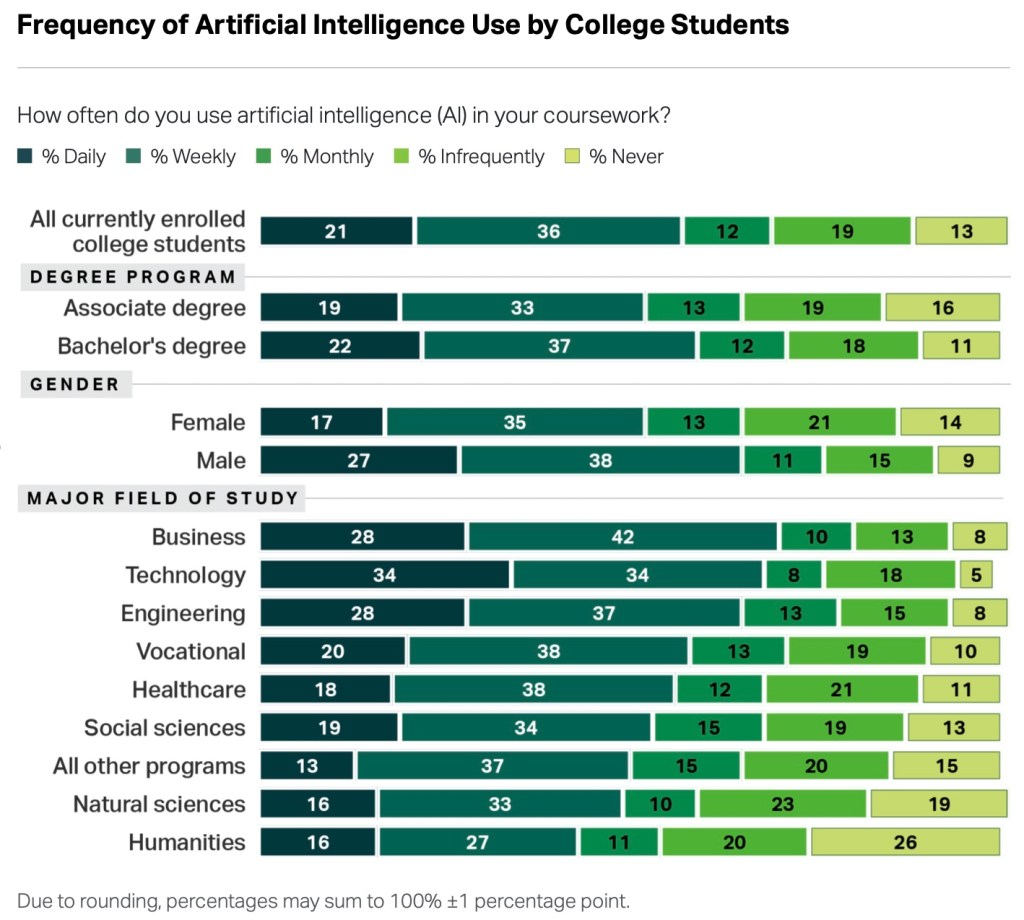
Putting the two charts together it is not surprising that computer science, technology, engineering, and business students make the most use of AI. It is also not surprising that arts and humanities students are among those using AI the least.
There are some uses of AI in the arts and humanities, and as a significant media technology, AI should be studied from disciplinary perspectives within those majors.However, the economic proposition of generative AI is that activities currently requiring human intellectual labor can be performed more cheaply by machines. In that quite literal sense, its economic function is to reduce the market value of human thought. As such, the more an intellectual practice values human deliberation as its end rather than merely as the means of producing an output, the less obvious the value of replacing that deliberation with AI becomes. From the arts and humanities perspective, developing a capacity for deliberation as humans is a primary goal, and it is not one easily supported by a technology designed to circumvent deliberation.
For example, today in my Critical Software Studies class we were talking about why we all decided to write regularly on word processors instead of paper. Gen AI can output the proxy of a response to that topic, as it has been well-covered online. However it can’t answer that question individually for each of us. AI can produce a text that is alienated from us—our experiences and thinking. But the motive for considering this question is not to gather facts about the arrival of office software and the spread of home computing, yadda yadda. The motive for this question is to investigate the human condition such that these are our experiences. The material-historical conditions are important to study in a class like this, but I didn’t ask the students the question so that they could reproduce a history. I asked them so they might situate themselves and their experiences within that cultural shift.
My other reading of these studies is that they might indicate which fields can be most easily automated and replaced by AI. Will the wonderful world of AI need computer scientists, engineers, business analysts, etc? Perhaps these charts reveal which fields are most amenable to automation.
On the other hand, who cares what some AI outputs about “The Red Wheelbarrow”? An AI might produce an interesting interpretation, but that does little to contribute to the experience of making meaning. On the other hand, a group of humans can sit in a class and discuss a poem with the result being a meaningful, valuable experience, even if the interpretations they develop are familiar to literary scholars. Does an AI have any role to play there except as a curiosity? And if we are writing poetry or making a film or designing a video game? Sure, an AI might output a poem, film, or game.
But so what?
One of the central reasons that the arts are academic disciplines is that they produce knowledge through practice and craft. Prompting an AI to write poems could be an art form, I guess, but beyond the experimental, if we are in a class writing poetry, then AI has little or no legitimate use. Engineers, programmers, and analysts might stop their practices and AI can continue them. But AI cannot continue human expression. It can continue an unfinished poem, but it cannot continue my writing of a poem, because once the AI takes over, I have ceased the experience.
Meanwhile the primary capacity for human expression one learns in AI-dominated fields is to express yourself in a way that conforms to AI functionality. And since AI functionality keeps shifting, teaching students this year’s optimal prompting techniques is the overripe banana of education. If you learned to shoe a horse, that may not be a very valuable skill, but at least you could still use it in 5 years. Knowing how to use an AI in 2026 is no guarantee of knowing how to use one in 2030.
So perhaps in some of these reports, the premise is to see which fields have managed to adopt AI most quickly and which are falling “behind,” but I’ve framed these findings in a different way. From my perspective, low AI adoption in the humanities isn’t necessarily evidence that they are falling behind. It’s evidence that we still know what we are trying to teach.
 Alex Reid, Professor of Digital Rhetoric, Media, and Artificial Intelligence
Leave a comment