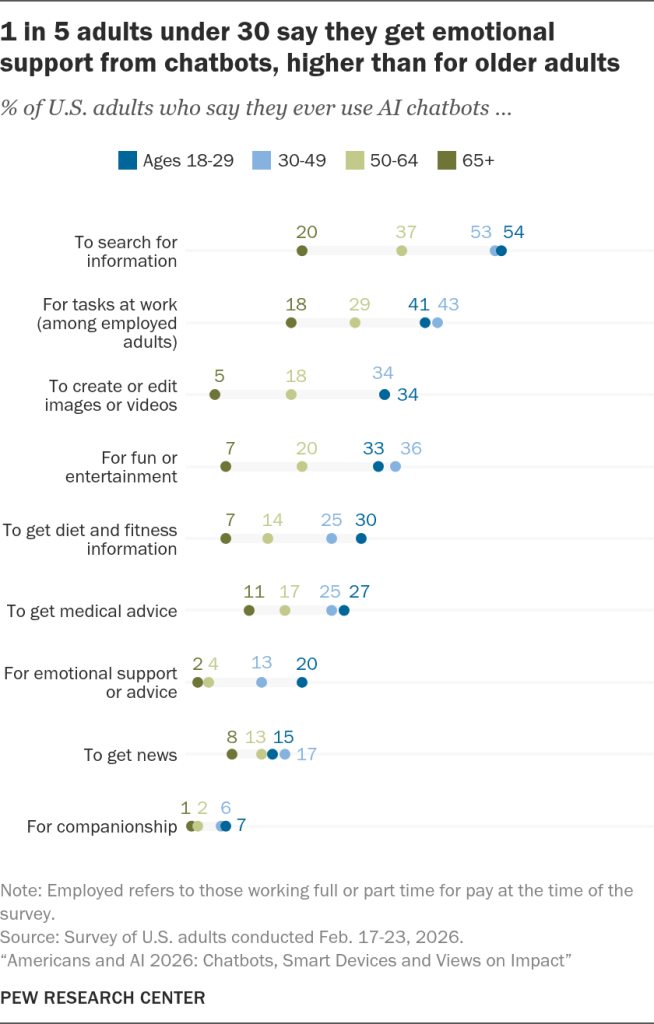
For the first week of class, I’ve put together some of the recent findings from the Pew Research Center that addresses generational responses to AI. These charts come from two summer reports: “Americans and AI 2026: Chatbots, Smart Devices and Views on Impact” (June 2026) and “Young adults in the U.S. are increasingly wary of AI, concerned it will take jobs” (August 2026).

The two courses I am teaching “Social Media and Networks” and “Critical Software Studies” converge on AI from different directions and concerns. So I thought we might begin with a question about the question. Specifically, I am curious with how the students in these classes respond to the way their generation is characterized (whichever generation that is, but mostly Z).

Adults ages 18–29 are the most likely age group to predict that AI will have a negative effect on society over the next 20 years: 48% say its impact will be negative, compared with 35% of those 65 and older. Young adults are also somewhat more negative about AI’s effect on them personally. Older adults, however, are much more likely to say they are unsure about AI’s future effects.
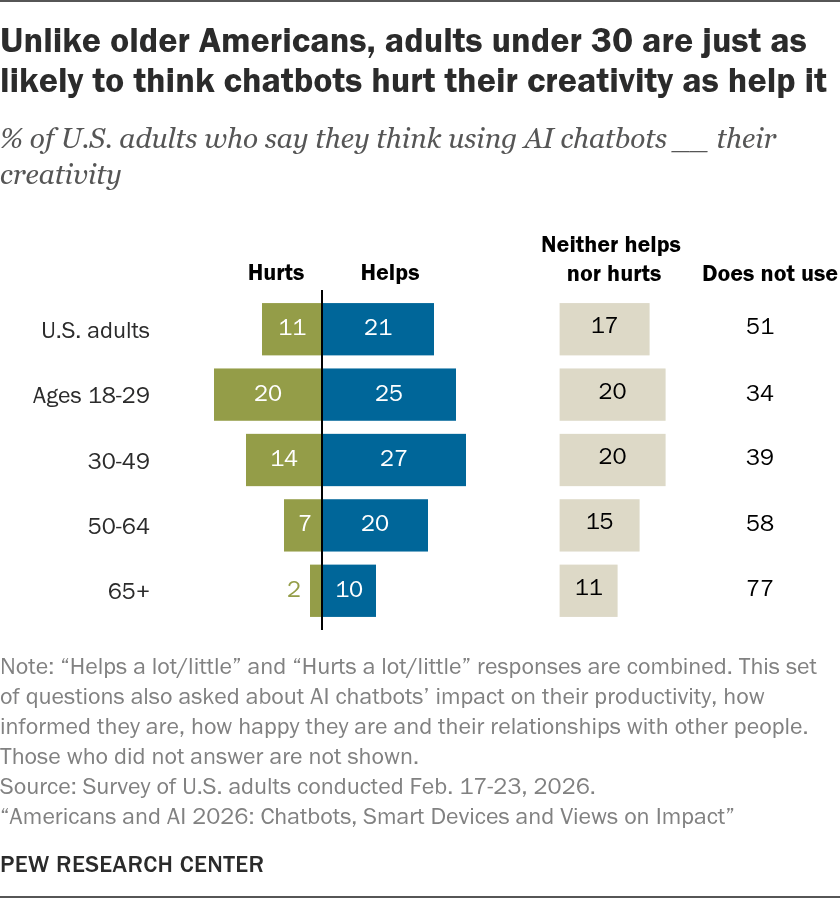
Among adults under 30, 25% say chatbots help their creativity while 20% say they hurt it—a much narrower gap than among older groups. Adults ages 18–49 are also much more likely to use chatbots at all, while 77% of adults 65 and older report not using them. The chart suggests that greater exposure to AI does not necessarily produce a more positive assessment of it.
In 2021, 37% of Americans said they were more concerned than excited about AI, compared with 18% who were more excited than concerned. By 2026, 52% were more concerned and only 9% more excited. Most of the shift occurred between 2022 and 2023, around the emergence of widely available generative-AI systems.
In 2021, adults ages 18–29 were the least likely age group to say they were more concerned than excited about AI. By 2026, 55% said they were more concerned than excited—almost as high as the 59% reported among adults 65 and older. At the same time, the share of young adults who are more excited than concerned fell from 25% to 11%. The striking story is therefore not simply a generational difference but a rapid change in the attitudes of young adults.
Between 2024 and 2026, the percentage of 18–29-year-olds who expect AI to produce fewer U.S. jobs over the next 20 years rose from 61% to 73%. That puts them essentially even with adults ages 30–64. Concern rose in every age group, but the increase was greatest among the youngest adults.

Leave a comment

Trending