The NY Times reports today “U.S. Workers Are More Productive Than Ever. A.I. Isn’t the Key. Companies have been getting more out of employees for several years.” Golf clap for companies. What does it mean to “get more out our employees”? The American mythology is that increased productivity makes everyone’s life better, but this apparent victory lap suggests something else. It might suggest that not all of us are sharing in the benefits, or more precisely that our increased output is in services that are worsening our lives as means of extraction from us as consumers, citizens, and workers.
As faculty we might ask, among other questions, what role we wish to play in preparing students as workers for this economy.
Here is the chart at the top of that article, based on Bureau of Labor Statistics data.
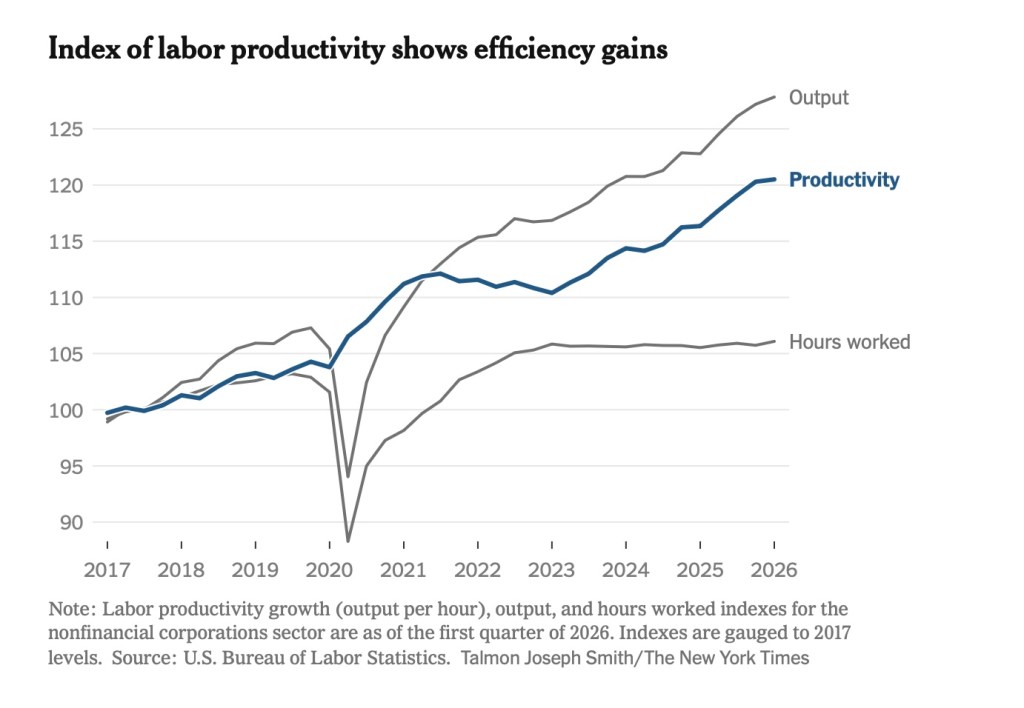
Briefly, increased productivity is when I can make more widgets per hour with fewer inputs, including labor. However, when we stop measuring physical widgets, it does get a little more complex. For example, when my streaming service rates increase and they offer some new services (e.g., 4k streaming, new programs, etc.), maybe that’s productivity and maybe it isn’t. Increased profit doesn’t necessarily equal increased productivity, not even in BLS calculations.
[I had failed to realize until recently how much economics was going to factor into the study of artificial intelligence.]
According to the BLS the sectors that saw the biggest productivity gains from 2019-2024 were in cable and subscription programming, travel services, and gambling. As I am learning, digital services are surprising hard to measure in terms of real productivity gains as opposed to simply raising prices. However, we have all experienced the increase in subscription prices and the increasing shift of things we wish to purchase into subscription models. I’m not sure how many of us have experienced these new costs as improved services.
This is Cory Doctorow’s enshittification. From my eye, and I am doing pattern recognition, I see the upswing in that chart as following the emergence of algorithmic capitalism. We can think about that as the way we have been targeted as consumers and citizens. But enshittification is also how we are targeted in the workplace. Here also is where the concept of the reverse centaur emerges.
For example, Uber can report its earnings, but it doesn’t have an accurate measure of how much time its drivers spend doing their jobs because the boundary between working and not working erodes. (As a professor I resemble that remark in a different way but then that occurs around a lot of remote work as we call it these days.)
The Times article ends with this line: “Mike Skordeles, the head of U.S. Economics at Truist, a bank based in Charlotte, N.C., said he was already producing more research than previously — a result of improved tools for data analysis and modeling. Only a few years ago, he said, ‘I would have had or hired three lower-level junior economists doing some of the charting and stuff that I can now do with the click of a button.’”
Congratulations on your new life, Mike? What can Mike do with his new research? Where does he find the time to read more research? Or does he just condense more research via AI summarization into the same amount of content that he actually reviews? In any case, it certainly underlines Doctorow’s point that the real appeal of AI is that it helps our bosses achieve their lifelong goal of firing us.
But there is another issue. We have had periods before where productivity increased while labor did not. We called them “jobless recoveries.” In this case, the low unemployment rate suggests that isn’t happening, but unemployment doesn’t measure underemployment. People with multiple gig jobs who still can’t make their rent are employed. Another way of reading this chart is that workers are being exploited as our compensation hasn’t kept up with productivity. Of course we know where the money is going.
While part of the point of this news story is to observe that these upturns aren’t about generative AI. The sales pitch about gen AI is that it can bring the algorithmic efficiencies of the Amazon warehouse to the corporate office park. We can hardly wait to see mid-level managers peeing into plastic bottles because they don’t have time for a bathroom break.
Perhaps the most important thing to consider about economic output is that we don’t actually make “widgets.” The cultural value of our output is not generic even if money finds it fungible. We can measure an output increase in the extrusion of AI content to produce many times over the amount of messaging we once did if it generates more ad revenue, subscription fees, etc. But have we produced an increase in cultural value? In part that’s an argument about AI slop, but it’s more than that.
If I use AI to triple my scholarly output, I might increase all of my academic metrics. Let’s all do that. Now what do we have? 3 times more of the stuff we already had more of than we could read. Has higher education become a more productive industry because professors are publishing triple the research?
.
 Alex Reid, Professor of Digital Rhetoric, Media, and Artificial Intelligence
Leave a comment