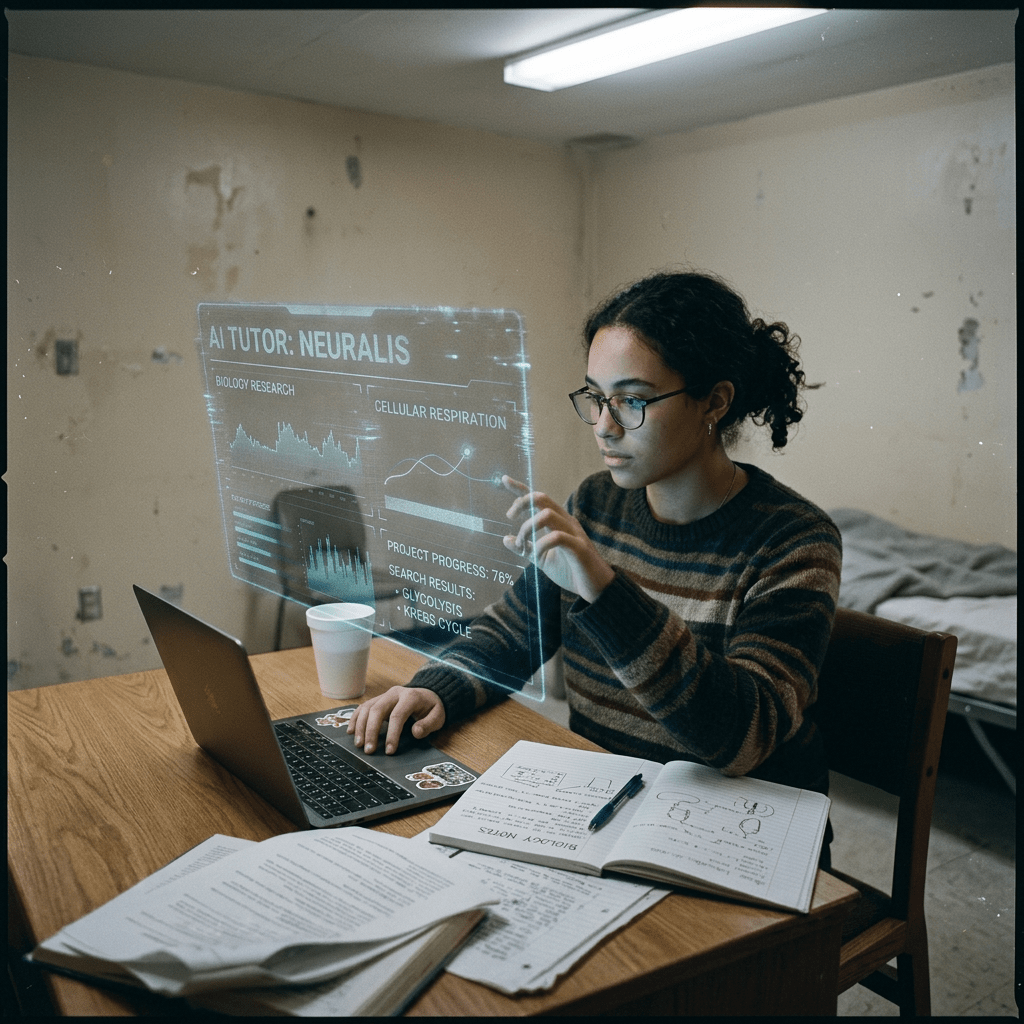
Understandably there is a lot of talk around AI tutors as a way of designing a new interaction layer on AI that shapes its processes of predictive continuation toward pedagogy rather than helpfulness. Or something like that, in a nutshell.
If we envision AI tutors as attached to a discipline or a particular course, then part of the story is that faculty would develop these for their own courses. Some have and more will. But mostly this sounds like a job for textbook and educational technology companies. E.g., here is your physics 101 textbook with a code to access its AI tutor. These products will have to balance the “friction” they create versus the opportunity students have to turn to other AI products. There is no AI tutor that addresses the faculty concern that an answer to any prompt is always at hand.
Tutors of this variety skirt the edge of being agentic in the contemporary frontier AI sense. Some might be, but most wouldn’t need to be. However, I expect there are a growing number of agentic AI in the administrative areas of campuses: in advising, financial aid, marketing, and so on. As such, their appearance on the curricular side won’t be surprising, especially if we want tutors to draw on longitudinal information about a student. E.g., maybe Jonny is struggling here because he struggled with a similar concept in Sociology 101.
In turn though, students (and faculty and staff) would be wise to invest in their own AI agents that are designed to interface strategically with institutional AI agents. Students with their own powerful AI (tutor) agents can tune them however they wish. At some point, having your own AI agent will be necessary for digital survival. I have to wonder what it would look like inside the university course management system when 30,000 agents having nothing better to do than operate inside it. The best I could imagine was if instead of a fleet of Waymo vehicles, a city had a thousand independent AI agent cabbies. You’d want to have guardrails, but how would you enforce them? I’m not saying it would be impossible. Rather, I’m saying you wouldn’t vote for it until you knew you had figured out the guardrail problem. Right now though it strikes me that we are trading stochastic parrots for stochastic triggers.
It’s largely too late for that now in the university context, unless we are going to say AI agents are bad while insisting that our students learn how to vibe code.
In all of this, it might be worth noting that the “AI tutor” is a myth. There’s an interesting version of it in Neal Stephenson’s The Diamond Age. In that novel, the learning machine is voiced by a woman (Miranda) who is a “ractor,” an actor in interactive media. Miranda provides the durability of attention and care. Otherwise, this is no AI tutor. An AI can’t be a tutor anymore than it can be anything else. Does the AI go to sleep at night thinking of the student they worked with and will be seeing next week? Do they dream of electric students?
The relationship with frontier AI, regardless of how many additional layers are wrapped around it, is a relationship with predictive continuation. It is a relationship that assumes that the appropriate response can be found in the prompt, that the right answer is the one that correctly responds to the question. We can modify its prediction of the right answer, the unfolding of its modeled helpfulness, where it looks for an answer, and the genre in which it outputs. But it is still predictive continuation. It is still the same model of intelligence.
I think that it is reasonable to expect that AI agents will demonstrate the shadow side of Metcalfe’s Law. Sure, faxes and email addresses get more valuable the more there are until spam happens, until your university sends you 20 emails every day. Then we invent AI agents to deal with our email. Rinse and repeat.

 Alex Reid, Professor of Digital Rhetoric, Media, and Artificial Intelligence
Leave a comment