I’ve been asked to discuss CCCC’s recent resolution on the right to refuse AI. I have already written about it here. From my perspective, this particular resolution is an academic freedom issue within a single discipline and largely focused on one kind of course: first-year composition. As this course is often taught by adjuncts, graduate students, and contingent faculty, it is also connected to protecting these classes of instructors from undue pressure. Outside of the field, the document is most useful for its collection of the variety of positions from which faculty in the field refuse to use AI. Most of these positions would apply outside of the discipline.
So I will talk about that, but I have this other thought on refusing AI, which I have illustrated roughly with three Venn diagrams. In figure one, AI is understood as a part of culture. This implies that mathematics, computer science, and the related scientific and technical fields most closely associated with AI should be understood as cultural. This means, among other things, that AI is shaped political and ideological motives. But more broadly it means that AI is a part of what culture does and not outside culture.
Conversely, figure two asserts that AI (and its associated STEM fields) can fully explain culture such that non-AI produced explanations of culture become unnecessary. Finally, figure three then suggests that there is some overlap but asserts that neither can account fully for the other.
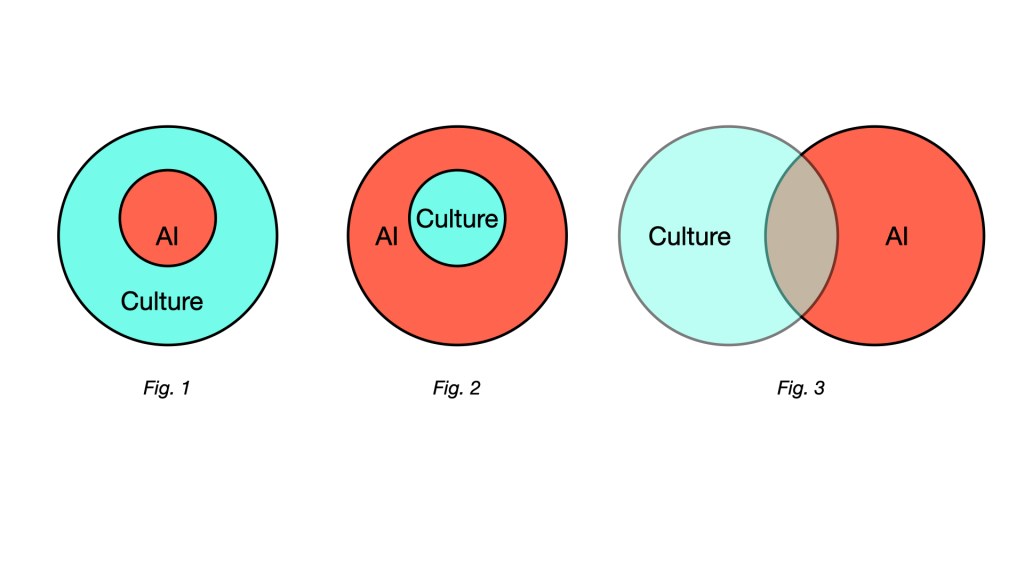
Presented this way, each of us must accept one position while refusing the other two. With the first two figures, most would find one of those positions unacceptable from a disciplinary perspective. This is in an update of the science wars in some sense. In the context of the first two, the third appears as a kind of peace settlement between opposing campus.
The sensible alternative is to reject this staging of the situation. There are more positions. And I agree. This is an over-fitted and intentionally provocative mapping. In this alternative argument, we would need to argue that there are many different views on the relationship among disciplines and how they will intersect with AI. But before we address the subtlety we should recognize that our institutions general lack it.
As an institution, my university has absolutely decided on figure two. Our curricular moves are all around how AI can explain everyone else’s disciplines. I doubt that’s unusual among our peers. Why do they do that? For trillions of reasons obviously. Of course I refuse figure 2. I don’t really understand why anyone who doesn’t own a frontier AI company would agree with figure 2.
But figure one needs greater nuance. And this begins with recognizing that “culture” and “AI,” while designating oversimplified disciplinary perspectives are internally quite different. We have many different and often contrary theories, methods, and practices for the study of culture. As such, while figure one asserts that AI (and STEM) are a part of culture, the figure does not imply a particular method that must be used to value AI. Instead it would suggest that AI is a part of culture that produces knowledge that we can study in many, often contrary, ways.
Within this perspective figure 3 can take on a new interpretation. As figure one could never assert that one method can fully exhaust the meaning of anything, from inside of AI the experience would be like figure 3. That is, in figure one the knowledge AI produces could never be fully determined by some external perspective. Yes, some might argue that AI is overdetermined by another aspect of culture, but those someones would likely disagree on what that was. Meanwhile others would disagree with all of them. AI could also make these kinds of arguments. That is, AI, like all aspects of culture, can produce knowledge. But AI’s supremacy wouldn’t be predetermined by the model of the university.
Figure one and figure three become two perspectives of the same set of relations. Conversely, figure 2 asserts that all conflicts will be resolved by the development of an ethical AGI. Figure one includes. Figure two dominates.


Leave a comment