A quick refresher for those who have missed earlier episodes: consensual hallucination is a reference to William Gibson’s description of cyberspace in Neuromancer. It connect significantly with the challenges of hallucination and alignment. (Apparently one of the first ways we want AI to align with our intentions is that it not present us its “hallucinations” as reality.) However, as I have been discussing here, and is not news from a posthuman perspective, it’s all hallucination, mate. There is noise. And from that noise, I hallucinate a signal. It remains a hallucination until others agree with me (like an eyewitness whose testimony is weighed by the jury). Then it becomes a consensual hallucination, i.e. a “signal.” We have consensus that this bit of noise is indeed a signal and we verify that fact among ourselves through discourse, i.e., additional layers of consensual hallucination. Then at some point we try to solidify/materialize our consensus. E.g., the jury makes a verdict and the court takes a material action, sentencing the now convicted felon to prison time, perhaps.
So that’s “consensual hallucination.”
One caveat: we are all aware of the public’s declining faith in academia and its declining interest/valuation of the arts and humanities. We also know about the decades of attacks from the political right. That’s all relevant, but secondary to my focus, which is internal to academia.
If I had to claim one discipline (and it’s hard to claim more than one, really), it’s rhetoric. I could push for media studies but only because it is so interdisciplinary and thus loosely defined. I might do have opinions about other disciplines, especially those in the arts and humanities with which I interact the most. But they shouldn’t (and don’t) value those opinions. And I would say I would treat their opinions about rhetoric similarly. Cutting across the humanities in different directions, we have further specializations, research methods, and theoretical orientations. E.g., if I am a new materialist/posthuman theorist (which I am, if I am anything of the sort), then I am not a Marxist or feminist or psychoanalytic critic or whatever. The same conditions apply.
I’m not saying that we don’t have feelings about all this business. To the contrary! It is the internecine warfare of the humanities that defines what we do. And I don’t think it is restricted to the humanities. I think it is a common quality of academic life. E.g., generally faculty will agree their institution should hire more tenure-track faculty. But the faculty in history aren’t agitating for hires in chemistry or visa versa. And I don’t think there’s anything new there or unique to academia. It’s just our institutional version of competition. Every institution has its own version. We could even try to say something naturalcultural about biology and competition but we wouldn’t want to stray into social Darwinism. And that’s not even the point here anyway.
The point is that once we start seeing the agonistic character of higher education as just another instantiation of chest thumping then we lose the consensual hallucination that this all results in some valuable signal. Forget about whether or not the public places any value on what the humanities say, do humanities faculty place any such value? Of course they value the work they identify with. But other work? That’s just grist for the critical theory mill; publications come out the other end.
Yes, this is nothing new. In the 1890s, life got so intolerable in English departments that a big part of the discipline went off and formed speech departments (which later became communication departments). Other disciplines have similar stories. Look at all the departments in various Studies fields that were created 40-50 years ago. These stories are considered triumphs. E.g. we drove off our detractors to solidify our community; we set off on our own to pursue a grand new vision; etc.
This isn’t a new problem. It’s one of those old, enduring problems that you’ve put up with for years but at some point there’s a limit. You’re familiar with that kind of problem, right? The humanities act is wearing thin; the way we perform these disciplines is getting tired. At least in the sciences there’s always a new machine that goes bing that can spark some changes. The humanities don’t change. The actors change but the format of the show doesn’t. The names of the theories or fields switch but the argumentative structures do not. It’s always a judgment according to some concocted evaluative criteria that can only function to the degree that we admit that such arguments count as signals.
Historically, of course, the consensual hallucination was that the humanities revealed essential truths about life and our character as a people/nation. That swayed into more secular versions that were more historical than essential, but we still held those ideals close to our hearts (free will, rationalism, etc.). Then that consensual hallucination stopped working and could no longer form a moral-ethical authority for making evaluations or judgments. Today we mostly have politics. For example, we have no consensual hallucination about justice. The humanities make many claims about the public sphere and about each other internally about the in/justice of actions. But what can the impact of such arguments be if justice is no different from taste or style? Just an ad hoc set of criteria agreed upon by some relatively small community (e.g. a scholarly field). That’s the humanities consensual hallucination fraying. Without a common criteria there cannot be signals, and agonism stops being about some negotiation of differences and more about noise cancellation.
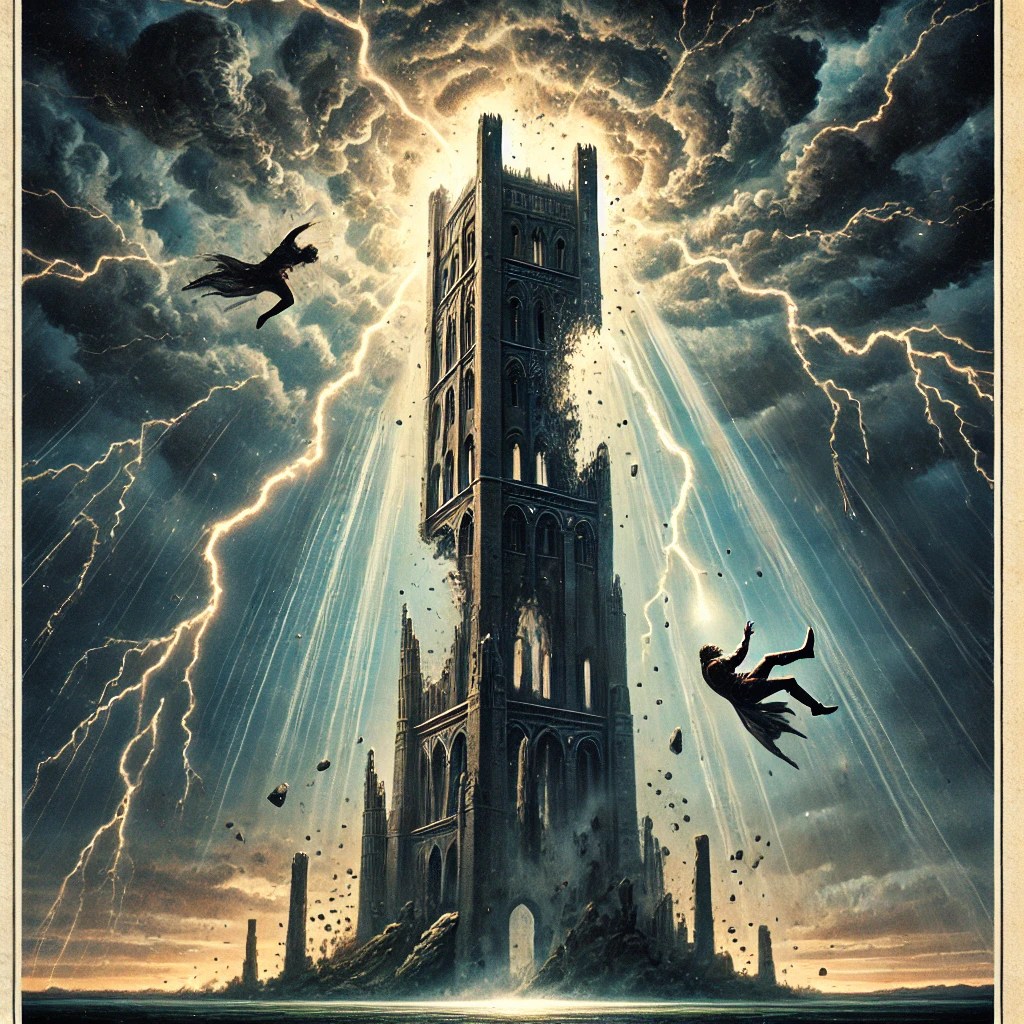
In short we find ourselves in a tower of babble.
Obviously I’m not saying that we need to find some new consensual hallucination. Hallucinations don’t function properly when you see them as such. It’s no more likely that we are going to start believing in some new Santa Claus than it is that we’ll go back to believing in the old one. It’s a kind of existential crisis where you realize that all the work you are doing is meaningless, just like life in general. You can create an ad hoc system for making your own life meaningful and maybe even share that system with others. But that’s much harder and less durable than a compelling consensual hallucination like a religion where you actually believe you are receiving signals from a god.
Honestly, hallucinations are not bad. They are necessary. To quote, Emily Dickinson, tell all the truth but tell it slant. Why? Because to quote Jack Nicholson, you can’t handle the truth. Humans don’t have the capacity to see the “truth” anyway. It’s all hallucination, but it only works when you forget it’s a hallucination. And we do that all the time… because we must to survive.
The problem for the humanities is that there is no imperative for us to forget that they are hallucinations. And it is difficult to forget because most of what we do is accuse one another of hallucinating.


Leave a Reply