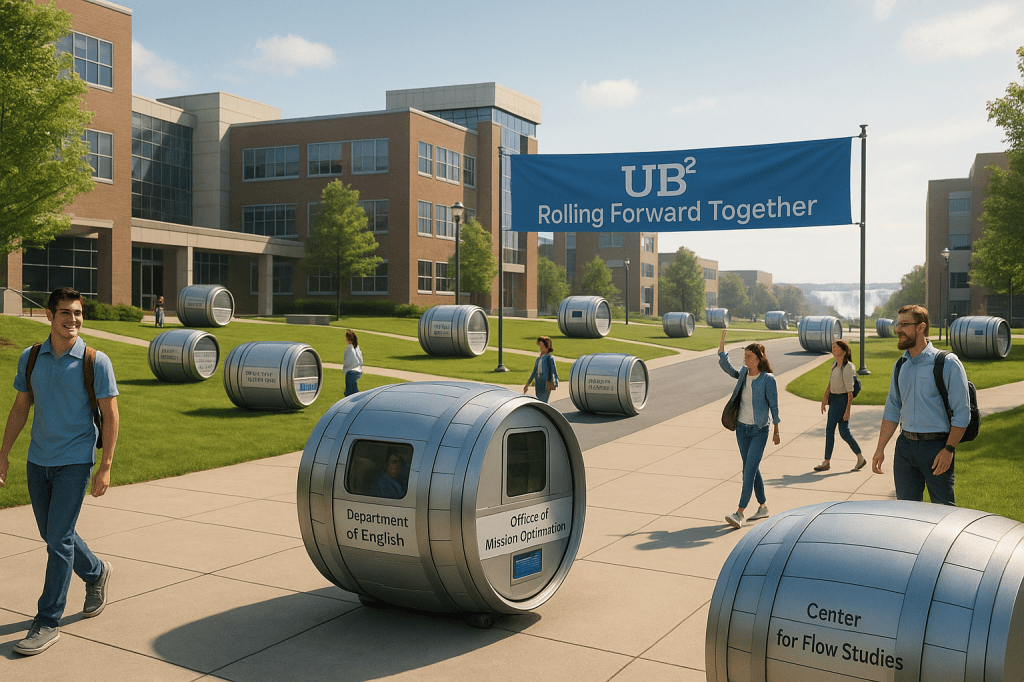
James Bridle discusses render ghosts, at least that’s where I first encountered the term. Think of the people that are drawn into the worlds of architectural renderings as a baseline and then move out toward all the now AI-generated render ghosts in the world.
The render ghost university (RGU) is the ghost of a university that is drawn into a data visualization of university activity. As department chair, I had access to university databases through a Tableau interface in which a number of workbooks had been created. Those are fairly unsophisticated examples of university render ghosts. While render ghosts are representational, representing how a space might be inhabited, they are also predictive and enactive. An architectural rendering is a vision. It says, “Let’s live in this world.”
There is a render ghost of the “top-25 university” as an assemblage of familiar metrics. One way, perhaps the only way today, to pursue the vision of being a top-25 university is to develop tactics and strategies to encourage the material university to express itself metrically, to render itself, as top-25. Obviously being rended is not much fun, much like being the site of extraction. Nevertheless, it’s a living.
One way to think through this is with a speculative, generative experiment in the bizarro world of RGUs. [and yes you can hear the machine writing at times below. What better way to render a ghost?]
The University at Barrels: Barreling into the Future!
The city of Barrels, the regional mercantile hub, known for the revolutionary storage technology that bears its name, draws strength from the University at Barrels. Long known for its strengths in the humanities, arts, packaging sciences, and coffin design, the 21st century university has turned its expertise to information packets and storage. With the arrival of AI, the University at Barrels announces its uBar (UB²) innovation: a visionary reimagining of campus infrastructure that merges ancient wisdom with modern efficiency.
Through a bold, cross-sector partnership between the Office of Academic Agility, the Division of Strategic Motion, and the Department of Treacherous Water Crossings, UB² introduces a new era of rolling excellence. Each faculty office, classroom, and administrative suite will now take the form of a fully autonomous barrel, equipped with precision gyroscopes, self-alignment motors, and mission-oriented positional analytics.
“Our goal,” the Provost explained in a recent town hall, “is to ensure that every faculty member, student, and department is always in optimal relation to the university’s mission — spatially, strategically, and spiritually. No one should ever be standing still.
Using the university’s proprietary Agile Alignment Algorithm, the barrels autonomously roll across campus throughout the day, constantly recalibrating their position relative to key performance indicators. A creative writing class might find itself gliding gently toward the Center for Innovation in Economic Narratives, while a philosophy seminar might be reoriented — for the fifteenth time this semester — toward “Applied Ethics in AI Commercialization.”
Barrels without current funding roll more slowly, a design feature that administrators describe as “encouraging self-motivation.” Faculty who wish to accelerate may submit a “Mobility Enhancement Proposal” through the new BARREL-FAST Portal, which replaces the outdated “Chair’s Office.”
“Everything we do at UB²,” the Chancellor declared, “is about getting faculty where they belong — dynamically, data-drivenly, and with measurable velocity.”
A Tradition of Excellence, Rolled Forward
The design philosophy draws inspiration from Diogenes of Sinope, the ancient Greek cynic who made his home in a barrel. Diogenes rejected the material pretensions of Athens, choosing instead the simplicity of a mobile dwelling and the freedom to mock convention.
UB² honors this legacy by updating cynicism for the 21st century. “In a world of constant change,” the Vice President for Mission Mobility explained, “the true cynic is the one who adapts to optimization imperatives with cheerful indifference.”
Thus, the university invites all faculty to “live cynically” — to embrace the barrel not as confinement, but as empowerment. Each barrel contains an integrated display cycling through the institution’s strategic plan, mission statement, and current U.S. News ranking. “Transparency and reflection,” reads the installation guide, “are the twin virtues of modern cynicism.”
The new Department of Treacherous Water Crossings’ Flow Corridor
The next phase of the initiative extends beyond campus. With state and federal support, UB² will establish a 28-mile stretch of continuous motion between campus and the famous Barrel Falls. The falls and barrels have a long history as the durability of the barrels was made famous by bootleggers who used them to send liquor over the border and the falls.
Every barrel is an epistemic capsule, an agent of continuous reconfiguration. Its rolling is not arbitrary but algorithmic, determined by fluctuating performance metrics, citation velocities, and donor thermodynamics. To roll, then, is to exist within the calculus of institutional time.
The department is planning a new doctoral program in the automated and artificial intelligences of predictive barreling. More information will be appearing about the Ph. uBar.
As UB² continues to expand, the administration invites feedback through the new Continuous Motion Feedback Mechanism (CMFM), available via QR code on the exterior of each barrel. The form asks only one question:
“How well aligned do you feel with the mission?”
Responses are automatically converted into motion parameters.
The future of higher education, it seems, is not a place but a direction. The University of Barrels has no fixed address, only coordinates that update every minute. In its rolling motion, it finds the perfect synthesis of philosophy and policy, cynicism and compliance, gravity and grace.
UB² — Roll Barrel!.
 Alex Reid, Professor of Digital Rhetoric, Media, and Artificial Intelligence
Leave a comment