
The idiomatic phrase “in the loop” belongs to the information economy long before it belongs to artificial intelligence. It emerges alongside mid-twentieth-century efforts to integrate human bodies and minds into systems of command, control, and communication—fighter pilots wired into cockpits, operators embedded in feedback systems, subjects trained to act at machine speed. From Manfred Clynes’s early work on the cyborg to Cold War C3I infrastructures and heads-up displays, being “in the loop” names a form of empowerment that is inseparable from connection. To be in the loop is not merely to know; it is to be plugged into a circuit that circulates information, authority, and action.
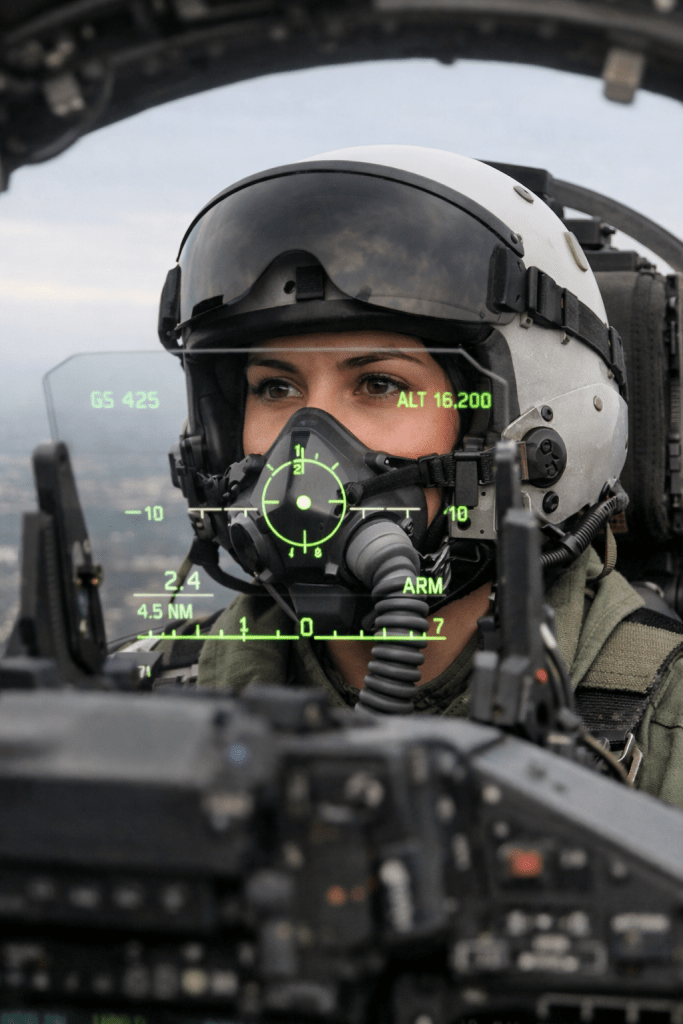
By the early 1980s, this language had escaped its technical origins and entered political life. Reporting on the Reagan White House, the New York Times Magazine could casually describe who was and was not “in the loop” around Iran-Contra—those privileged to be copied on memoranda, included in the circulation of judgment and decision. The phrase marks a shift in how power is understood and exercised: no longer primarily through sovereign command, but through inclusion in informational loops. As Michel Foucault helps us see, modern biopower operates not by standing above its subjects, but by running through them. To be empowered is, increasingly, to be connected
Foucault also provides us with a broader historical understanding of how looping develops from sovereign to biopolitical power. The most obvious example of the sovereign loop is the noose.
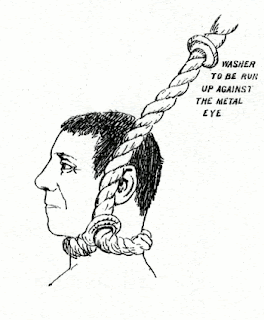
The noose, as we might say today, is designed to compete a circuit of judgment. We can also observe that the noose is the site where the judged are made response-able to sovereignty. The noose completes the circuit of justice by bisecting the operational circuits of the body.
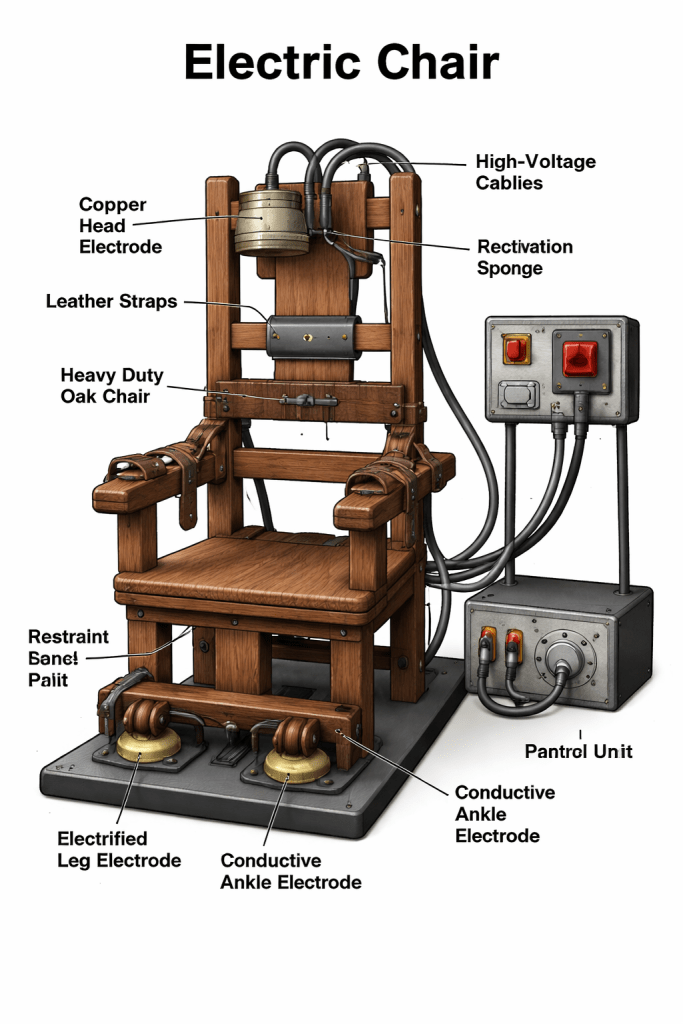
Nooses went out of favor in the mid-20th century and were replaced by a different form of circuit completion and suspension. There are many humans, many actors, in the loop of a mid-century American state execution by electrocution. The condemned complete the circuit of judgement but many others participate as operators. This institutional circulation of biopower is what Foucault tells us to expect.
So how do we imagine our future humans-in-the-loop, plugged into “real-time” information landscapes, handling edge cases, and being positioned to absorb moral friction, like an ethical heat sink, so that the system can continue operating smoothly. These are humans in operative loops. Here, beyond Foucault, we need to consider the chronopolitical forces at work. Chronopolitics, as the expression of political power through the compression of time, develops the technical and legal power of AI output to outspeed human deliberation. In other words, ethics are suspended rather than considered when AI operations anticipate and precede the time of ethics in order to circulate command, control, and information more quickly. The human in the loop bears the burden for this circulation. For an anticipatory AI, humans in the loop are potential operational inefficiencies to be avoided. This is by design. The function of AI ethics is to avoid the delays of judgment by avoiding outputs that invite judgment.

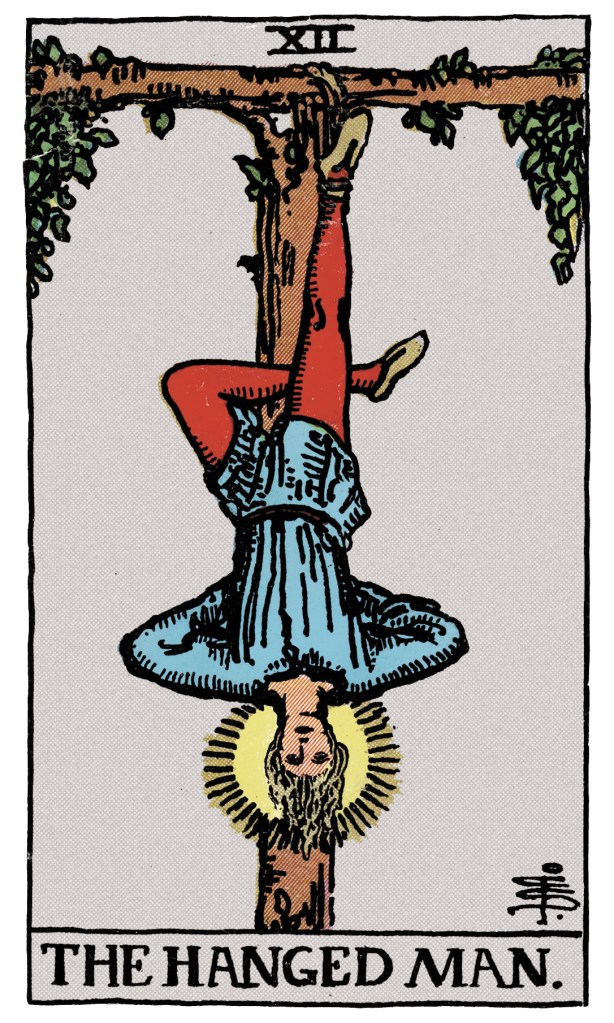
There’s actually one other element to consider here with loops. The Hanged Man emphasizes the suspension of decision, a surrender, an acceptance of exposure. Again this is a matter of suspension and circulation, but in this case the circulation is inoperative. These are key matters for Nancy’s observation. Life is the circulation of meaning. Circulation is captured as operative as part of mythologies that promise purpose and closure (as opposed to the existential, exposed condition of the inoperative). Rather than stopping here to make some ethical observation, the key point is elsewhere. The key, for me, is in recognizing the collapse of the C3I mythology and its panoptic human-in-the-loop.
There are serious ethical issues. We cannot rely on these mythologies, especially not with AI. AI, as we approach it currently, is an almost pure mythology of operationally itself. The point I take from Nancy (and others) is that this mythology (like the others) can never work. We can narrate the neuroscientific Predictive Self as an image of purely operational self, but that would fail to recognize that the Predictive Self is overselling itself a bit. It should maybe be called the Mistaken-prone Self. Or even worse, the Predictable Self.
The Predictive Self couldn’t survive as a predictable self. The aim of reducing surprise must be asymmetric if it is to have value. With this in mind, though we are always exposed to the other (“poker face”), our operation, our continued survival, relies on keeping things hidden about ourselves. In turn this makes us less than fully operational to some other community. Looping, circulating, meaning in Nancy’s inoperative community accepts, must accept, the exposure of loops circuits and suspensions. It has to recognize the costs and the burdens.
In the genealogy of loops we discover a new chronopolitical condition. As loops have moved from the sovereign circulation of justice through the suspension of life to the biochronopolitical circulation of anticipation through the suspension of judgment. It is not that judgment is avoided or deferred. It simply never arrives.
 Alex Reid, Professor of Digital Rhetoric, Media, and Artificial Intelligence
Leave a comment