This understanding is as familiar as Plato. We didn’t need to wait for Foucault or Barthes or Derrida to recognize the category error in conflating writing with thinking. Until the printing press, human hands (and thus human thought) participated in acts of inscription. Writing required human cognition to move the pen (or whatever) across the page.
We managed to salvage that initial technological disruption by shortening imprint or impress. So by the 1500s we had printers and writers in different categories or we tried to. I’m not going to go into Kittler and the typewriter except to note how he notes the observed discontinuity of thought that is experienced by Victorian and Modernist writers in switching from handwriting to typewriting. Here we might begin to consider the idea that writing is a distributed-cognitive practice.
Decades before Gen AI, computer networks wrote and communicated with one another without human participation in media forms that are not human readable. They were already making up the bulk of Internet traffic. Indeed, none of the signals written by a computer and sent down a fiber optic cable are human readable or composable.
I’m assuming I’m not telling you anything you don’t already know, so let’s jump ahead. While I am all for inclusivity, I don’t see how writing is a human. Writing itself isn’t human. Humans can do it. Humans also eat. Many things that aren’t human also eat or think and/or write.
Writing is not evidence of human ontological exceptionalism. As an activity, it is something we and others can do. As an object, writing is an other we can encounter.
From an English Studies perspective, assigning value/grades to humans on the basis of my interpretation of a piece of writing with their name on it is a comical enaction of the intentional fallacy. If I cannot attribute my interpretation as the intention of the author, then how can the author be held accountable for it? And we can get more sophisticated than New Criticism on this matter obviously.
Assigning grades to students on the assertion that “their” writing reveals their thoughts to me such that I can hold them accountable is simply an unethical activity. It is the patient zero of academic dishonestly from which all other student academic dishonesty flows.
It is more productive to understand grading as biopolitics than as objective judgment. The assemblage/apparatus of biopolitics captures humans and subjects them to disciplinary imprinting. Writing as a (confessional) biopolitical technology of the self facilitates this imprinting. We might say that in Deleuzian control societies this imprinting shifts toward a sub personal, micro political modulation. As such, we are now perhaps less likely to say “this is a ‘B’ student” and more likely to measure intersectional variation (e.g., cultural differences, linguistic differences, cognitive/embodied differences, etc.). The grade still sticks though because we have the institutions to make sure it does.
In this environment, where GenAI is available, what is the appropriate political and ethical response to the professorial, disingenuous and hegemonic insistence that students’ bodies are held accountable for faculty readings?
What GenAI has done, in my view, is expose the fragile fiction that legitimates writing as tool for student evaluation.
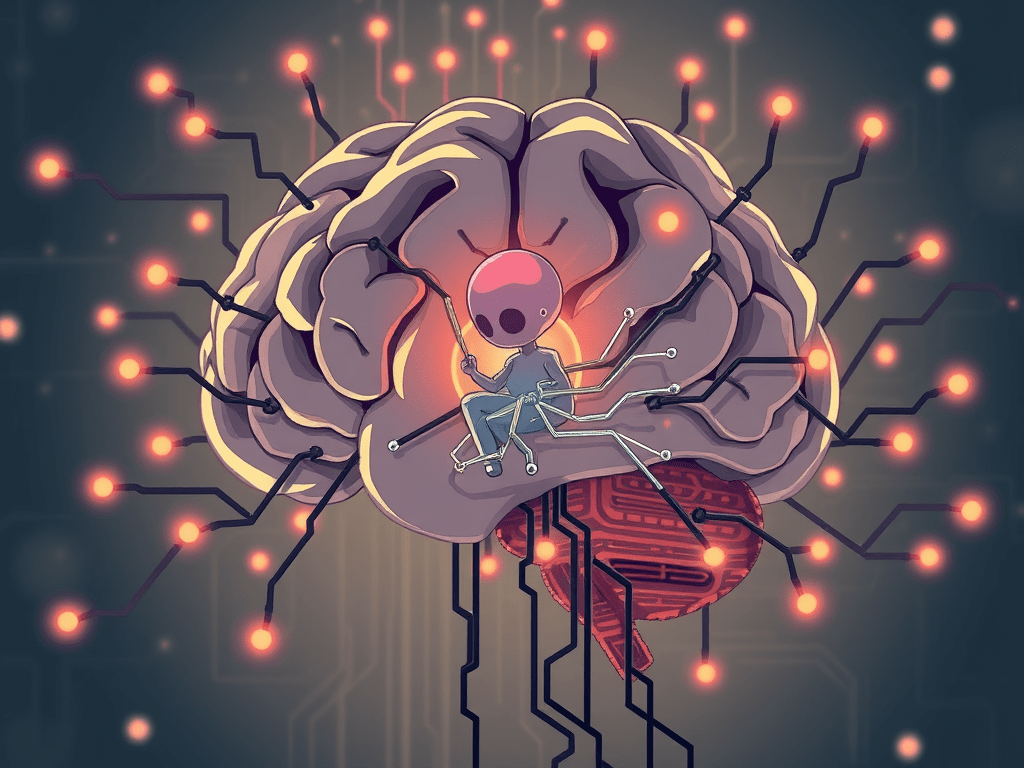
We actually have a deeper problem. There’s no doubt that when humans are writing, the brain lights up. I’m not saying human cognition can’t play a role in writing. It even plays a role when students ask GenAI to generate a response to an assignment. Our deeper problem is in our mythologies about that cognition. It is as if we imagine some linguistic version of Maxwell’s demon: some homunculus gathering thoughts together into order.
The fact that I could write my dissertation in a semester instead of taking years wasn’t because I had so much more expert knowledge than colleagues who took longer. It was just a Jedi writing trick that I could practice and others didn’t. The same trick worked in undergrad for blue book exams and the short papers they’d ask us to write. It wasn’t like you had to read the novel you wrote the paper on or show up to the class you took the blue book final in. Because the writing activity never had much to do with domain knowledge. And you’re not trying to outrun the bear.
Does this mean I was “cheating myself” by not reading and studying? I don’t think so. I just disentangled activities that weren’t really dependent on each other, which made the activities easier to do. A student writing an assignment is confronting the operation of biopolitical power and needs to respond strategically. This is hardly the time to be confusing the activity with other purposes.
I learned plenty, especially about institutions and hegemony.
 Alex Reid, Professor of Digital Rhetoric, Media, and Artificial Intelligence
Leave a comment