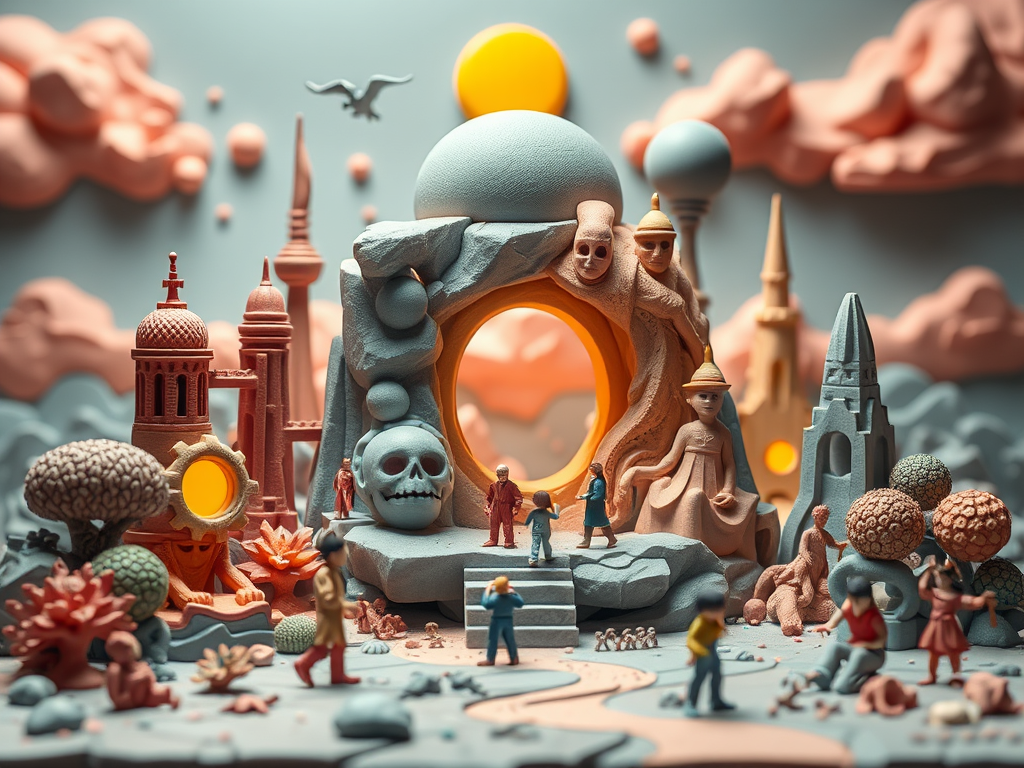
In Archeology of the Future (2005), Frederic Jameson invokes the semiotic square in an investigation of utopias. And then this square evolves. So we have utopia and its opposites: anti-utopia and dystopia (1984, Brazil, Brave New World). We also have anti-anti-utopia which aligns with critical utopias (Moylan, etc.) where we find authors from Ursula LeGuin to Kim Stanley Robinson but other contemporary authors like Annalee Newitz, Ada Palmer, Cory Doctorow, Becky Chambers, Elizabeth Bear, and Malka Older (to name some that I have read). These are worlds, like Newitz’s Terraformers, where the protagonists engage in the messy work of making things better, of pursuing the imperfect utopia as the best option. (I mean, should we be trying to make things worse?)
It’s a messy grouping, and most novels lean more in the anti-utopian direction with utopian impulses. That is, the world is mostly horrible but we still try to find a way for ourselves, keeping open the possibility of reaching a critical-utopian world rather than just an anti-utopian one. The other category would be the non-utopian worlds where capitalism is played out in full regalia. S.A. Corey’s The Expanse would be a good example or Daniel Suarez Delta-V, more niche but even better. Even there, people try to live their lives and have revolutionary dreams. There’s just little sense that those dreams will lead to anything different than where dreams have led before. It’s the depressing/cynical assertion that we will never have enough individual or collective agency to produce a world that is better than “not absolutely horrible for everyone.” Or something like Mary Robinette Kowal’s Lady Astronaut series, which is more of a realist, social progressive world than a utopian one would also fit into this group.
Robinson’s Ministry for the Future remains the best example for me of a critical utopian world. But to be clear, all of the novels are enjoyable depending on whether you are looking for something “for the beach” or for a journal article. But I digress.
As we might expect from Jameson, his anti-anti-utopian semiotic square is one in which a new dialectical synthesis between the utopian and anti-utopian results in something like a critical utopia. However, as we might expect from me, I am not so committed to thinking about this process as dialectical. Instead, I want to characterize this square in terms of posthuman theory. I also wanted to focus the question of critical utopia on the subject of AGI. With some image generation assistance, we came up with this meshwork.

I’ve read most of these authors as well, and rather than saying this maps out something about their own ideological commitments, I’d say that it would be an error to assert that William Gibson wanted to realize the world he imagined anymore than George Orwell did, even if Silicon Valley has pursued Gibson’s Matrix as if it were a blueprint. (Just so we are clear on that, sigh.) Exploding the square into a mesh offers different ways of thinking about how critical-utopian speculation might operate. In my view, generating these spaces produces/describes more opportunities than having fewer boxes and asking us to fight/dialectic it out.
Is should be unsurprising that academic work is strongly held to the non-utopian worldview, except in specialized spaces. The breathless boosterism of market AI discourse from academia and elsewhere moves toward utopian dreams: the inevitable capitalist reality will lead to utopia. Maybe you have heard that song before? Problem solving, the primary academic mode, is not utopian in its approach.
That said, some works push in that direction. A reading list? Sure, whatever. I have taught of version of this as a graduate course (some different readings).
- Ruha Benjamin (Race After Technology, 2019).
- Sasha Costanza-Chock (Design Justice, 2020)
- Donna Haraway (Staying with the Trouble, 2016)
- Rosi Braidotti (The Posthuman, 2013).
- Karen Barad (Meeting the Universe Halfway, 2007)
- Benjamin Bratton (The Stack, 2016)
- N. Katherine Hayles (Unthought, 2017) .
Perhaps we need to go backward and forward. We’ve got one wheel in a ditch and one wheel on the track. Academic work has become increasingly territorialized on a discursive frame. That’s for another time, but in shifting toward some kind of affirmative ethics we might loosen the genre boundaries. After all, if we are uncertain about what AI may be, then why are we so certain we know how to talk/write about it? In these texts, the gesture moves toward let’s make things better rather than make them worse while realizing that we will not be clearly successful (or successful at all) no matter what. Because, what is the other option? That’s critical anti-anti-utopia as we have it.
We live in a world of wicked problems and collective experiments. Something other than the utopian/dystopian binary needs to steer our imagination and something more than non-utopian thinking needs to provide the force. We can see this being worked out in fiction, but how far can we stretch the concept of non-utopian realism as an academic discourse?
That’s a rhetorical question but I’ll give one partial answer. We can stretch this concept of realism far enough to realistically suggest that a machine can be intelligent.
 Alex Reid, Professor of Digital Rhetoric, Media, and Artificial Intelligence
Leave a comment