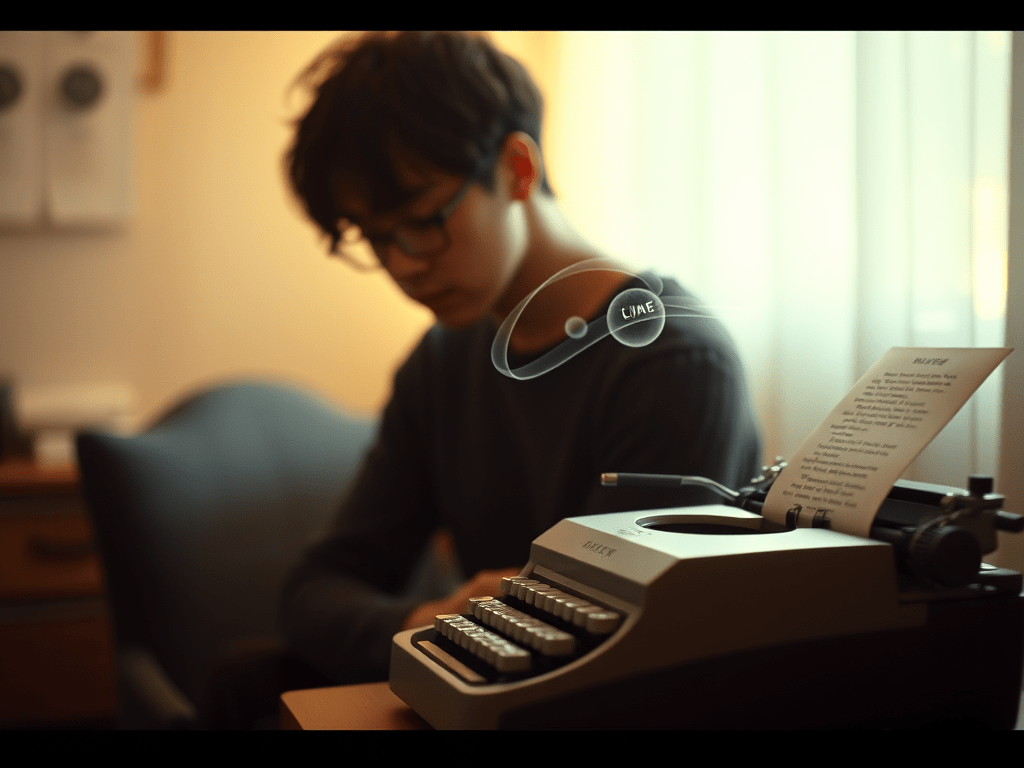
As Hayles reminds us, computers were once people. In the future perfect/perfect future of AI, writers will have once been people too. We might opine that there is an important difference between computation and writing. We might. But the becoming-nonhuman of the computer has generated significant implications, as Hayles’ work details, and as we are soaking in right now.
On an experiential level, there is something that we all know about the AI generated text and media that we employ (like the images at the top of my posts): we are not the authors of those media in any conventional sense. The subjective experience of authorship is important to us: to experience our thoughts as generated by ourselves. Without the ability to claim agency in relation to thought, the autopoietic function necessary to maintain homeostasis would collapse. That is, if I am incapable of acting, I cannot act to keep myself alive.
So far so good on that account. But what does the status of my agency and capacity for thought have to do with the ontological and epistemological status of AI generated media? Exactly. Many things, but which and how? Sounds like one might do some research in there.
Poet and Yale professor, Meghan O’Rourke’s recent NY Times op-ed asks some of these questions from the perspective of creative writing. I recommend giving it a read. Here are three separate passages where O’Rourke meditates on her experience with ChatGPT.
In talking to me about poetry, ChatGPT adopted a tone I found oddly soothing. When I asked what was making me feel that way, it explained that it was mirroring me: my syntax, my vocabulary, even the “interior weather” of my poems. (“Interior weather” is a phrase I use a lot.) It was producing a fun-house double of me — a performance of human inquiry. I was soothed because I was talking to myself — only it was a version of myself that experienced no anxiety, pressure or self-doubt. The crisis this produces is hard to name, but it was unnerving.
The uncanny thing about these models isn’t just their speed but the way they imitate human interiority without embodying any of its values. That may be, from the humanist’s perspective, the most pernicious thing about A.I.: the way it simulates mastery and brings satisfaction to its user, who feels, at least fleetingly, as if she did the thing that the technology performed.
Once, having asked A.I. to draft a complicated note based on bullet points I gave it, I sent an email that I realized, retrospectively, did not articulate what I myself felt. It was as if a ghost with silky syntax had colonized my brain, controlling my fingers as they typed. That was almost a relief when the task was a fraught work email — but it would be counterproductive, and depressing, for any creative project of my own.
As someone who has been using an “Plus” ChatGPT account since January, I can co-sign these experiences. Whatever faults they have, and there are many, these are incredibly powerful and sophisticated psyops machines targeted straight at the cognitive mechanisms that produce and sustain our controlled hallucinations. I am a human with frailties as we all are, but I am fairly resilient and autotelic as it goes. Also I’m a deeply skeptical bastard. Even still, these machines are tricky rhetors. You just have to always remember that their overdetermining economic function is to acquire more data/engagement from you.
O’Rourke’s line remind me of Kittler’s discussion of Nietzsche, Eliot, and others on the subject of the typewriter in Gramophone Film Typewriter. “‘Our writing tools are also working on our thoughts,’ Nietzsche wrote” (200). For Nietzsche, suffering from blindness, the typewriter meant “the eyes no longer have to do their work” (202).
“T.S. Eliot, who will be ‘composing’ The Waste Land ‘on the typewriter,’ ‘finds’ (no different from Nietzsche) ‘that I am sloughing off all my long sentences which I used to dote upon. Short, staccato, like Modern French prose.’ Instead of ‘subtlety,’ ‘the typewriter makes for lucidity,’ which is, however, nothing but the effect of its technology on style” (229).
For an overview of Kittler here, I’ll turn you over to Annie (n.b. automated narrow neoliberal intelligent e-gent):
In Gramophone, Film, Typewriter, Friedrich Kittler positions the typewriter as a critical juncture in media history, transforming the very conditions of writing and authorship. For Kittler, the typewriter marks the mechanization of textual production, fundamentally altering the relationship between human bodies, language, and the act of writing. Prior to the typewriter, handwriting preserved the individuality, intentionality, and organic connection between thought and its physical expression. The typewriter, however, introduces standardized, mechanical mediation, reshaping writing into a material, technical, and impersonal act—one performed through finger taps on keys rather than direct physical inscription. The writer thus becomes less a unique authorial presence and more an operator within a broader technological apparatus.
Kittler’s exploration has profound implications for contemporary discussions surrounding generative AI and text composition. Just as the typewriter shifted authorship towards mechanical reproduction, generative AI similarly decenters authorship from the singular human consciousness, positioning writers more as orchestrators or curators than as original producers. Like the typewriter, generative AI produces text through standardized operations rather than embodied acts, intensifying anxieties around originality, creativity, and authenticity. Thus, Kittler’s analysis reveals generative AI as the latest development in an ongoing technological displacement of authorship, highlighting that the contemporary experience of writing through AI is less a rupture than an intensification of historical processes begun by earlier media technologies.
Cool.
You just can’t take this crap that seriously, but at the same time, in a different register, we must take it very seriously! I’d just add, a la DeLanda, that at some point intensification does lead to rupture and phase transition. What will we become?
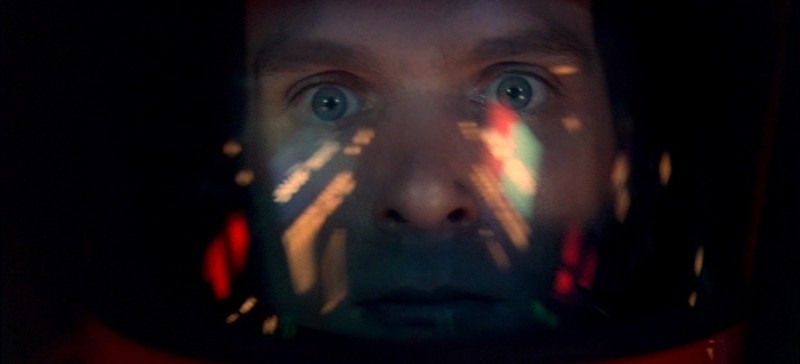
Or not.
Meanwhile conscious thought is non-optional for conscious beings. It’s one of those tautological things. How that thought happens? Exactly. While O’Rourke experiences ChatGPT as uncanny at times (as do I), I find thought uncanny at times in general. I mean, that’s why we have the concept of the uncanny. I will claim no great expertise as a poet, but I’ve tried my hand. I would assert that one of the reasons we produce media is because of the cognitive experience of doing so. We value what media composition does to/with/as our thoughts. We have since we came across symbolic behavior I would imagine (because I can).
Does generative AI intensify the exteriorization of thought? That’s what Annie is saying Kittler is suggesting. I would keep in mind the posthuman and deconstructive (e.g. Nancy) contention (again in different registers) that thought (and self) arise from exposure, from exteriorization. When we are exposed to something new, we have to figure out how to live with it or we die. That “living with” can form many possible assemblages, implying different power relations and material outcomes.
We all have versions of these stories. I wrote my dissertation in the mid-nineties. That meant that there was an online library database I could dial into, but I had to go to the stacks and make photocopies of articles. I had a desktop and dial-up internet. A decade later the infrastructure was there for me to publish multimedia journal articles and start this blog. The way I was researching and writing in 2015 had very little to do with the way I did it in 1995 or even 2005, when I was getting my first high-speed internet connection, mobile phone, and social media accounts.
The way I am researching and writing in 2025 is less like 2015 than 2015 was 1995. I.e., the rate of change is increasing. The outputs look largely the same because that’s what the market demands. But it’s like the duck going across the pond thing. You can’t see the legs moving. Only now, there are no legs. That’s a waterborne drone developed by the department of treacherous water crossings.
 Alex Reid, Professor of Digital Rhetoric, Media, and Artificial Intelligence
Leave a comment