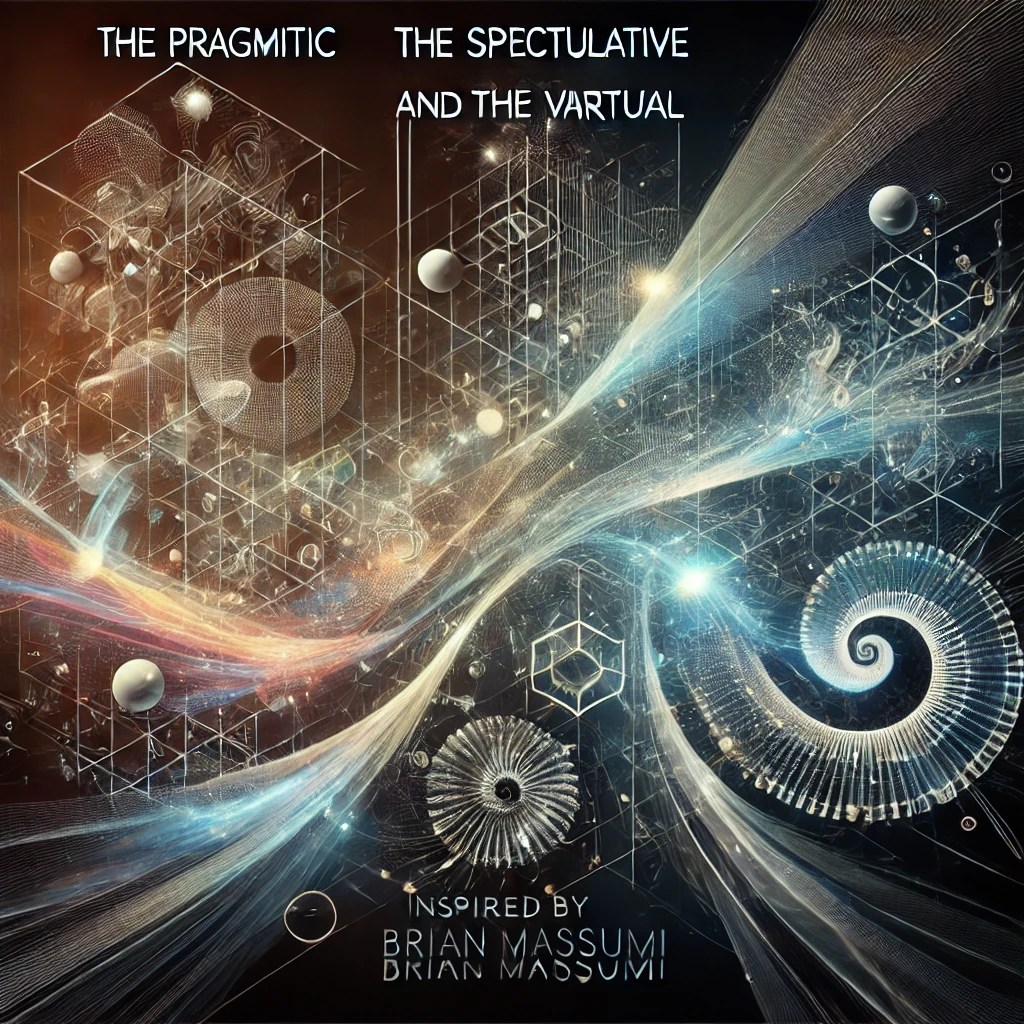
We’re talking about realities.
Brian Massumi describes his Deleuze-inspired version of speculative pragmatism as
anything potentially goes. But precisely because of that, every little thing matters — more than we can ever know in advance. Everything matters; but everything also matters on, following the singular trail of potential’s unfolding. To prove equal to the import, to follow the trail of the mattering-on, to honor the potential of the process, it is necessary to participate with great pragmatic and speculative care — and just as much artfulness. There is by the nature of this activity a political element to it. The art of mutual inclusion, with care: that could stand as the very definition of the political.
In my reading, Massumi’s speculative pragmatism is a practice/ethics for interacting within Deleuze’s virtual-actual circuit. That is, how potential unfolds into the actual, the real. I realize that many observe the words “speculative” and “pragmatic” to be at odds with one another. Speculative is associated with fancy and imagination, as well as the unlikely. Pragmatism is about reality and the likely. But speculating is also about seeing, just as theorizing is. It is about risk, but a measured risk as well, such as speculating in the stock market. Arguably the world no longer offers sure enough bets for one to be pragmatic. In that case a speculative pragmatism becomes the only pragmatic option.
Massumi’s speculative pragmatism also builds on William James’ radical empiricism… Oh, hell, here, just let AI explain it to you:
### Key Aspects of Brian Massumi’s Speculative Pragmatism:
1. **Affect and Experience**: Massumi is deeply interested in affect, which he defines as the pre-conscious, bodily intensity that arises before emotions are fully formed. Affect is about potential and the unfolding of experiences. Speculative pragmatism, in Massumi’s view, places a strong emphasis on the experiential dimension of life, focusing on how affect drives change and transformation.
2. **Process Philosophy**: Massumi draws on process philosophy, particularly the work of thinkers like Alfred North Whitehead, who see reality as constantly in flux. For Massumi, speculative pragmatism is about engaging with the ongoing processes of becoming, rather than static states of being. It encourages thinking in terms of potentialities—what could happen—rather than fixed outcomes.
3. **Speculation as Creative Exploration**: Massumi’s version of speculative pragmatism values speculation not merely as abstract thought but as a creative act that can open up new ways of understanding and interacting with the world. This creative speculation is not detached from reality; instead, it actively participates in the world by imagining new possibilities and directions for life and thought.
4. **Pragmatism as Experimentation**: While classical pragmatism emphasizes the practical effects of ideas, Massumi extends this to emphasize experimentation and process. Ideas are valuable not just because of their immediate practical effects but because they can generate new ways of being and experiencing. This experimentation with ideas is a key aspect of Massumi’s speculative pragmatism, which prioritizes the generative potential of thought.
5. **The Virtual and the Actual**: Massumi is also influenced by the concept of the virtual, a term drawn from Gilles Deleuze, which refers to the realm of potentialities that have not yet been actualized. In speculative pragmatism, attention is paid to both the actual (what is concretely present) and the virtual (what could potentially become). This creates a philosophical orientation that is open to emergent possibilities and unanticipated futures.
6. **Political and Ethical Dimensions**: For Massumi, speculative pragmatism has important political and ethical implications. It allows for a more dynamic and responsive approach to social and political problems by encouraging experimentation with new forms of life and governance. This openness to speculative possibilities enables a politics of emergence, where new forms of organization and social life can be created in response to changing conditions.
### Distinctive Features:
– **Focus on Potentiality**: Unlike classical pragmatism, which often emphasizes the practical consequences of ideas, Massumi’s speculative pragmatism is concerned with potentialities—those virtual possibilities that are always on the verge of becoming actualized.
– **Affective Dimension**: Massumi brings affect into the center of speculative pragmatism, focusing on how bodily intensities and pre-conscious experiences shape our engagement with the world and open up new possibilities for action and thought.
– **Experimental and Open-Ended**: Massumi’s speculative pragmatism embraces an experimental approach to philosophy, one that is open-ended and continuously evolving, rather than aiming for fixed, final outcomes.
### Conclusion:
Brian Massumi’s concept of speculative pragmatism is a philosophy of experimentation, affect, and potential. It challenges rigid distinctions between theory and practice by emphasizing the creative, dynamic processes that shape reality. This approach allows for new ways of thinking and acting, where speculation becomes a tool for generating new possibilities and experimenting with different ways of being in the world. Massumi’s speculative pragmatism, therefore, is about engaging with the world in a way that is both imaginative and deeply responsive to the complexities of lived experience.
OK, that was much easier than having to write that myself! Especially since what I want to do is use these concepts here rather than creating synopses of them.
So I’m thinking of some kind of offshoot I suppose, the way much writing is. A virtual pragmatism. Unlike Massumi, I wouldn’t present this as a strictly positive thing. Instead it’s more like a tool that can be used for a variety of ends, which is true of all tools.
As I examined in The Two Virtuals, there is the technological virtual, which is the world of simulation, and the ontological virtual, which is part of the virtual-actual circuit of becoming. (FWIW, my dissertation was titled “Virtual Prognosis,” so I’ve been at this for a while now.) A virtual pragmatism operates at the intersection of those two virtuals. That is, I am looking at the sites where digital, symbolic action is the means for identifying and realizing pragmatism. Deleuze’s control societies is a useful concept here.
It’s easy enough to mistake this for familiar critical theoretical arguments about ideological superstructures and mass media, as just more of the same old hegemony at work. It’s easy because all that late 20th century stuff continues to sputter along, though it’s really not made to last in the post-truth environment. But this is really something quite different from that and from earlier Deleuzian and posthuman work.
It’s different because the circumstances are different. I don’t love the term AI, but the role machine intelligences perform in composing and maintaining the naturalcultural world is a significant change in the order of things. Virtual pragmatism is the term I am thinking describes strategies of human negotiation with machine intelligences in the cognitive media ecology we share.
 Alex Reid, Professor of Digital Rhetoric, Media, and Artificial Intelligence
Leave a comment